Background
Selling energy to Europe
Tunisia has two energy projects pointed at Europe, and they are nowhere near the same stage. Elmed, the 600 megawatt electricity cable to Sicily, has its main contracts awarded, a cost put at about 1.42 billion euros and a service window of 2028 to 2030. The SoutH2 hydrogen corridor has a ministerial declaration signed in Algiers on 1 October 2026, a secretariat, and no answer yet on the technical and financial questions.
Elmed, the 600 megawatt cable between Tunisia and Sicily, has its main contracts awarded: about 770 million euros for the two conversion stations and about 460 million for the submarine cable, on figures Kapitalis takes from the Tunisian consultancy Aius. The SoutH2 hydrogen corridor, the other project pointed at Europe, has a declaration and a secretariat.
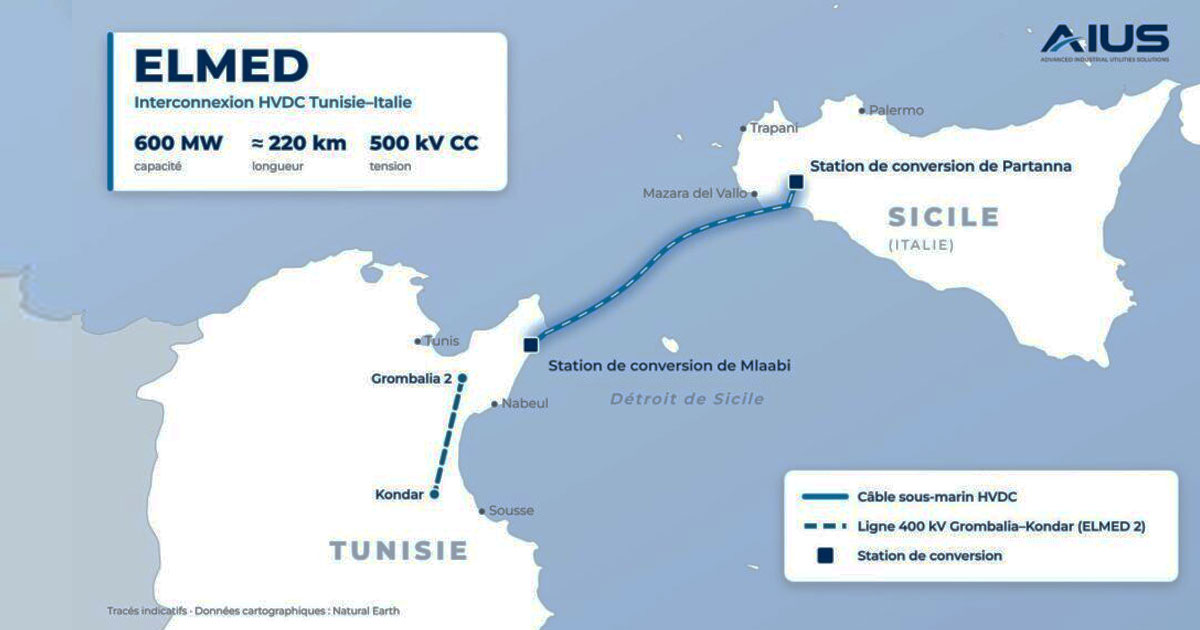
Elmed, the electricity interconnection to Italy, will carry 600 megawatts in both directions, at a cost estimated at about 1.42 billion euros. Kapitalis reports, from an update by the Tunisian consultancy Aius, that STEG and Terna awarded Hitachi Energy the two conversion stations in June 2026 for about 770 million euros, and the submarine cable to Prysmian for about 460 million. Service is planned between 2028 and 2030, subject to any new delay. Tunisia will be able to import from Italy as well as export.
Elmed's second phase is inside Tunisia, and it needs parliament. It strengthens the grid so electricity from the centre and the south reaches the north. It includes a 400 kilovolt overhead line of about 85 kilometres, from Grombalia in Nabeul to Kondar in Sousse. The European Bank for Reconstruction and Development signed its 43 million euro loan on 15 January 2026. On 2 November 2026 the bill approving Tunisia's state guarantee went to parliament's finance and budget committee, marked urgent. No vote on it had been reported by 29 November.
On Thursday 1 October 2026 the energy ministers of Tunisia, Algeria, Italy, Austria and Germany signed the Algiers declaration on the SoutH2 Corridor, which Webdo reports strengthens cooperation without yet settling the main technical and financial questions. It was their second ministerial meeting, after Rome in January 2025. The corridor would run about 3,300 kilometres, much of which could be existing gas pipelines converted to carry hydrogen. Webdo asks what place Tunisian production will have in a corridor whose first ambitions rest on hydrogen produced in Algeria.
On Friday 9 October 2026 a restricted ministerial council restated the 35 per cent renewables target for 2030 and listed what should come first: air cooling on existing units for 250 megawatts, a third gas turbine at Borj El Amri for 300 megawatts, gas engines for 200 megawatts, and Kchabta and Maktar back in service for about 190 megawatts. Nearly 300 megawatts of renewables should reach the grid by the summer of 2027. The projects the council listed include a 50 megawatt solar plant at Béni Mhira in Tataouine.
That plant now has its financing. On Wednesday 11 November 2026 Tunisia and the European Bank for Reconstruction and Development signed two guarantee and financing agreements worth 50 million euros for it. Economy minister Samir Abdelhafidh called it the first solar installation in Tunisia to pair a plant with storage connected directly to STEG's grid. STEG's chief executive Fayçal Trifa said work should start in the first quarter of 2027, with service targeted for the summer of 2028.
The numbers
Elmed, the cable and its contracts
600 megawatts
The interconnection will link the two sides of the Mediterranean through the Strait of Sicily with a bidirectional capacity of 600 megawatts, at a total cost estimated at about 1.42 billion euros, with service planned between 2028 and 2030 subject to any new delay. In June 2026 STEG and Terna awarded Hitachi Energy the two conversion stations, at Mlaabi in the Menzel Temime area of Nabeul governorate and at Partanna in Sicily, for about 770 million euros. The submarine cable contract went to the Italian group Prysmian for about 460 million euros, over roughly 200 kilometres. Kapitalis names several backers: the European Union with a grant of 307.6 million euros, the World Bank, the European Bank for Reconstruction and Development, the European Investment Bank and KfW. It writes that the link will run both ways, so Tunisia can import from Italy when its own production falls short.
Kapitalis attributes the contract figures to an update published that week by the Tunisian consultancy Aius, not to STEG or Terna. The page says so because the amounts are the most precise thing on it and they reach us through a consultancy's note.
Elmed 2, the phase that goes through parliament
43 million euros
The second phase reinforces the Tunisian national grid so that electricity produced in the centre and the south can reach the north and Cap Bon, and so that new renewable sources can be integrated. It provides for a 400 kilovolt overhead line of about 85 kilometres between Grombalia in Nabeul governorate and Kondar in Sousse, with further connecting lines between Ezzahra and Grombalia and between Seltene and Grombalia totalling about 20 kilometres, across the governorates of Nabeul, Ben Arous, Zaghouan and Sousse. Tunisia and the EBRD signed the financing agreement of 43 million euros, about 145 million dinars, on 15 January 2026, with a Tunisian state guarantee behind the loan to STEG. On 2 November 2026 the bill approving that guarantee, number 66 of 2026, went to parliament's finance and budget committee with a request for urgent examination. No vote on it had been reported by 29 November.
The Algiers declaration on SoutH2, 1 October 2026
Five countries
The energy ministers of Tunisia, Algeria, Italy, Austria and Germany signed the Algiers ministerial declaration on the SoutH2 Corridor on Thursday 1 October 2026. Webdo reports that it strengthens cooperation between the five countries without yet settling the main technical and financial questions, and that it provides for a secretariat to give the project technical support with the United Nations Industrial Development Organization alongside. It was the second ministerial meeting, after Rome in January 2025.
What the corridor would be, on its promoters' figures
3,300 kilometres
The corridor is meant to link renewable hydrogen production zones in North Africa to Europe's main industrial hubs through Italy, Austria and Germany, over a network of about 3,300 kilometres, a large part of which could be existing gas pipelines converted to carry hydrogen. Its promoters estimate that potential transport capacity could exceed four million tonnes of renewable hydrogen a year, with service envisaged at the start of the 2030s, subject to the technical, regulatory and financial steps. One link envisaged runs under the sea between Cap Bon and Mazara del Vallo in Sicily, carried by SeaCorridor.
The first plant with storage, on the minister's account, 11 November 2026
50 megawatts and 10 of storage
Tunisia and the European Bank for Reconstruction and Development signed two guarantee and financing agreements worth 50 million euros in Tunis on the afternoon of Wednesday 11 November 2026, for a STEG project at Béni Mhira in Tataouine: a 50 megawatt solar plant with 10 megawatts of battery storage, which the October account of the same plant measured as 20 megawatt hours, a substation and about 1.2 kilometres of high-voltage transmission line. The financing is 30 million euros at the bank's ordinary terms, at 1 per cent, and a concessional tranche of 20 million from the Clean Technology Fund administered by the World Bank at a fixed 0.62 per cent, repaid over 18 years with a grace period of 5 years, plus a 4 million euro technical assistance grant. Economy minister Samir Abdelhafidh said it is the first solar installation in Tunisia to pair a plant with electricity storage connected directly to STEG's grid.
The 35 per cent target, restated on 9 October 2026
35 per cent by 2030
A restricted ministerial council chaired by head of government Sarra Zaâfrani Zenzri restated on Friday 9 October 2026 the target of raising renewables to 35 per cent of electricity generation by 2030. STEG's short-term plan includes air-cooling systems adding 250 megawatts of capacity, a third gas turbine at Borj El Amri of 300 megawatts, gas engines totalling 200 megawatts and the full return to service of the Kchabta and Maktar plants, about 190 megawatts together. Nearly 300 megawatts of renewable capacity should be connected to the grid by the summer of 2027, with about 40 megawatts more in the fifth round of the authorisation regime. The projects listed include an extension of the Sidi Daoud wind farm of about 30 megawatts, a 50 megawatt solar plant at Béni Mhira with 20 megawatt hours of storage, and a 200 megawatt solar plant at Tataouine with 100 megawatt hours.
African Manager published this on Saturday 10 October 2026 and dates the council to the Friday, which was 9 October.
What the comparison shows
What nobody is saying
No source here gives a price for the electricity Elmed would carry, or a share of the hydrogen Tunisia would keep. None of them says what Tunisia would export while it is still building gas capacity to cover its own peak demand.
Our coverage