Friday, 14 August 2026 ··

Tunisia News

Tunisia · Europe · Geopolitics: the daily brief
Who says what · Seventy years of the Code of Personal Status

The personal status code turns seventy, and the loudest quarrel is over a category the notaries say does not exist

The Code of Personal Status was adopted on 13 August 1956. It banned polygamy, made consent a condition of marriage and put divorce before a judge. The anniversary falls in the middle of an open dispute. The president of the National Union of Tunisian Women says marriages concluded outside the Code are spreading, and has asked the public prosecution to check marriage contracts. The notaries answer that no such category exists in Tunisian law, and several of them want to take her to court. The other voices look past that quarrel. The feminist association ATFD presses for equal inheritance and wants the Code's discriminatory provisions repealed. An association that tracks femicides says the problem is not the text at all. And a journalist at Nawaat writes that the Code has been a balancing act since its first day.

Read the full comparison →

Tunisia

The trade deficit grew by 2.4 billion dinars in a single month

The trade deficit grew by 2.4 billion dinars in a single month

Tunisia's trade deficit reached 14,957.6 million dinars over the first seven months of the year, against 12.57 billion at the end of June, on figures the statistics institute INS published on 11 August. Cumulatively the deficit is 25.7 percent wider than the 11.90 billion recorded for the same period of 2025. Exports rose 9.9 percent to 40,638.4 million dinars while imports rose faster, 13.7 percent to 55,596 million, and the cover ratio fell to 73.1 percent from 75.6 a year earlier.

The state keeps the motorways and hands the A1 and A2 to Tunisie Autoroutes

The state keeps the motorways and hands the A1 and A2 to Tunisie Autoroutes

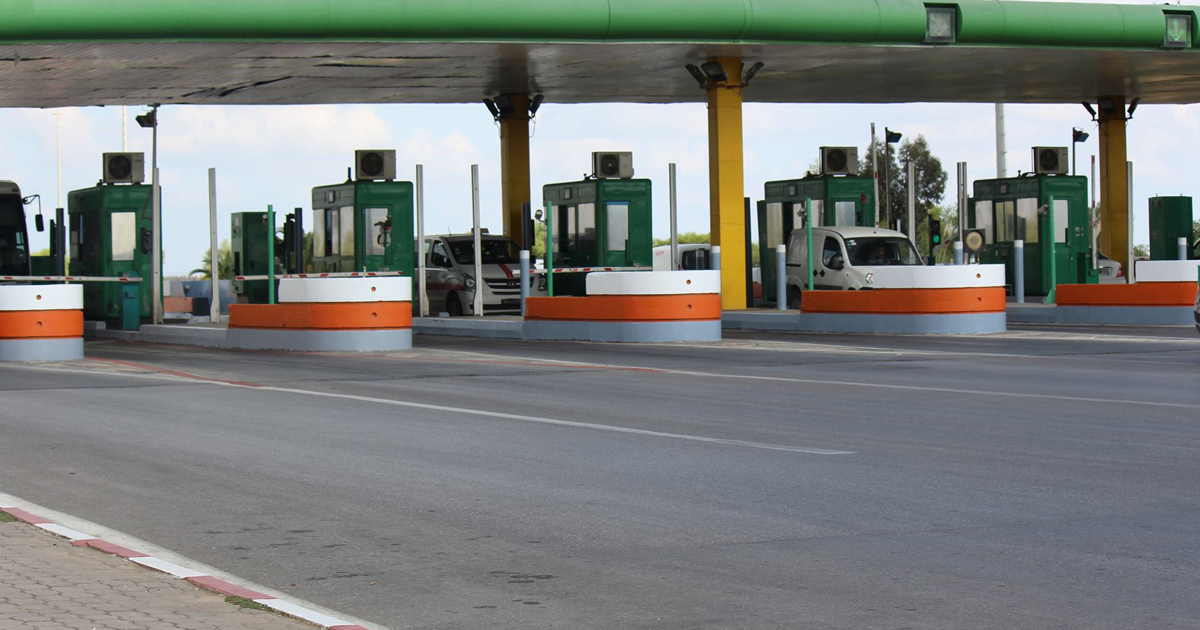
A restricted ministerial council chaired by head of government Sarra Zaâfrani Zenzri decided on Wednesday 12 August to sign two new concession contracts with the state company Tunisie Autoroutes: one for the Hammam Lif to Sousse stretch of the A1, whose current concession expires at the end of 2028, and one for the new A2 between Tunis and Jelma. The government justifies the choice by continuity of a service it calls strategic and by keeping the infrastructure under state control. The A2 runs 186 kilometres through Ben Arous, Zaghouan, Kairouan and Sidi Bouzid, is due for delivery in 2027 and costs around 1.7 billion dinars.

Aswat Nissa counts 30 women killed in 2025, against six in 2018

Aswat Nissa counts 30 women killed in 2025, against six in 2018

The association Aswat Nissa says 30 women were killed in Tunisia during 2025, one more than the year before, on a curve that runs from six cases in 2018 to 25 in 2023 and 29 in 2024. The association writes that the killings have continued into 2026 and speaks of the state's silence and its slowness in protecting women from violence. The figures land in the week the country marked seventy years since the Code of Personal Status was adopted on 13 August 1956.

Saied makes Boughdiri secretary general of the education council, two years after dismissing him as minister

Saied makes Boughdiri secretary general of the education council, two years after dismissing him as minister

The official gazette of Friday 14 August, issue 82, carries three presidential decrees dated 12 August. The first names seven members to the high authority of the Higher Council for Education and Teaching. The second makes Mohamed Ali Boughdiri the council's secretary general. The third convenes the council for its inaugural session on Monday 17 August. Boughdiri ran the education ministry from January 2023 until 1 April 2024, when Kais Saied ended his duties in an order that gave no reason. Before he entered government he was deputy secretary general of the UGTT with responsibility for the private sector. The council was organised by a decree-law of 16 September 2024.

Geopolitics

Putin visits the Kuril Islands for the first time and Japan protests

Putin visits the Kuril Islands for the first time and Japan protests

Vladimir Putin visited Iturup in the Kuril Islands on Thursday, the first trip there by a sitting Russian president, meeting the regional governor and visiting a fish-processing plant, a hospital and a school. Japan's Prime Minister Sanae Takaichi called the visit absolutely unacceptable and said it offends the sentiments of the Japanese people, while Foreign Minister Toshimitsu Motegi summoned Russia's ambassador. The islands were seized by the Soviet Union at the end of the second world war and Tokyo still claims four of them.

The Emirates accuse Iran of attacking two ADNOC vessels in Hormuz

The Emirates accuse Iran of attacking two ADNOC vessels in Hormuz

The Abu Dhabi National Oil Company said two of its vessels were attacked while transiting the Strait of Hormuz on Thursday evening and that the situation was brought under control, with no injuries. The Emirati foreign ministry condemned in the early hours of Friday what it called a hostile Iranian attack and said attempts to use the strait as a tool of economic coercion violate freedom of navigation. Iran did not comment, is maintaining its blockade and is in talks with Oman over the strait's future management.

Israel sends troops against settlers who have besieged Palestinian homes in the West Bank

Israel sends troops against settlers who have besieged Palestinian homes in the West Bank

Israeli forces moved on 13 August against settlers who had blockaded Palestinian homes near Nablus since 9 August, including one owned by a US citizen, and the military says it dismantled two outposts and detained one Israeli. The US ambassador Mike Huckabee, for years an outspoken supporter of the settler movement, called the act disgusting and said Israel intervened at Washington's request. On the same day Israeli ministers, among them Defence Minister Israel Katz, celebrated the reopening of the Ganim settlement in the northern West Bank.

Europe

A fresh heatwave over Europe, 42.5C in central France

A fresh heatwave over Europe, 42.5C in central France

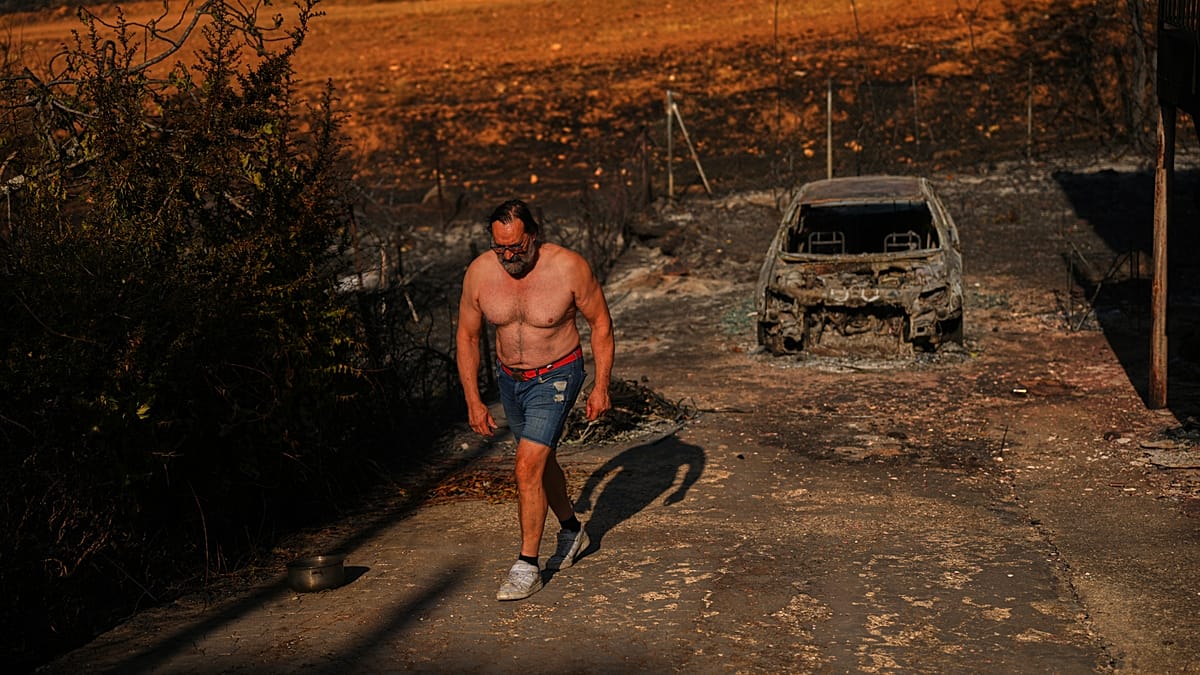
Météo-France recorded 42.5C at Chateaumeillant on Thursday, the country's highest reading of the day, while Paris reached 38C. On an AFP analysis built on German weather service forecasts, around 340 million Europeans were above 30C and more than 135 million above 35C. The United Kingdom logged its hottest day of the year and the Met Office expects its hottest summer on record, while wildfires forced hundreds of tourists to be evacuated by boat in northern Greece.

The EU's burnt area is the fourth largest in fifteen years, and Spain is 38 percent of it

The EU's burnt area is the fourth largest in fifteen years, and Spain is 38 percent of it

By the end of the year's thirty-first week, 489,826 hectares had burnt in the EU, according to Our World in Data drawing on the Global Wildfire Information System. That is the fourth highest reading at the same point in the year since 2012 and 13 percent above the 2012 to 2025 average. Spain accounts for 185,948 hectares, more than double its own average at this point in the year.

British growth slows to 0.4 percent in the second quarter

British growth slows to 0.4 percent in the second quarter

The Office for National Statistics said on Thursday that GDP rose 0.4 percent in April to June after 0.6 percent in the first quarter, with services up 0.5 percent as the main driver. It is the first quarterly reading since Keir Starmer resigned in late June and was replaced by Andy Burnham, with Reform UK ahead of Labour in the polls. Finance minister John Healey tied the pressure on households to energy costs following the war between the United States and Iran.

Topics